


2026-08-20



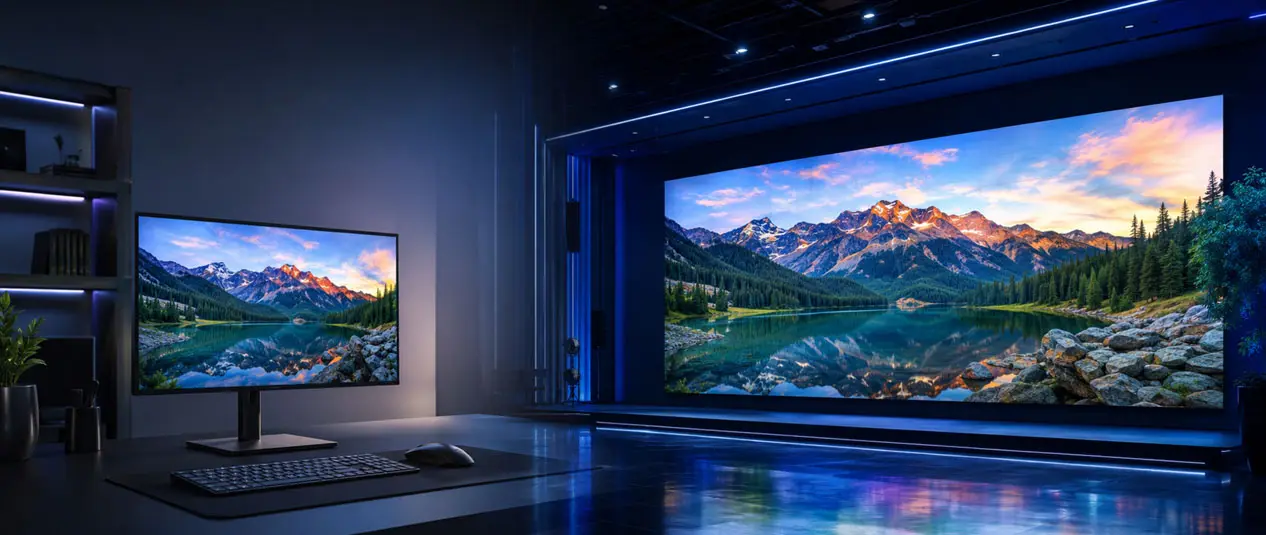
Un 16:9 aspect ratio LED display has a width-to-height relationship of 16 units to 9 units. It is one of the most widely used screen formats because it matches common Full HD and 4K video resolutions, presentation slides, livestreams and digital media.
For conference rooms, corporate auditoriums, entornos minoristas, control centers and event stages, choosing a 16:9 LED screen can simplify content production and reduce unwanted cropping, stretching or empty borders.
Sin embargo, achieving a true 16:9 LED display requires more than selecting a screen that looks rectangular. The physical dimensions, cabinet configuration, paso de píxel, total resolution and video processor must work together.
What Does a 16:9 Aspect Ratio Mean?
Aspect ratio describes the proportional relationship between the width and height of a display. Un 16:9 screen is 16 units wide for every 9 units high.
The physical dimensions can be calculated using the following formulas:
Screen width = Screen height × 16 ÷ 9
Screen height = Screen width × 9 ÷ 16
Por ejemplo, if the required screen height is 3 meters:
Width = 3 × 16 ÷ 9 = 5.33 meters
The completed display should therefore measure approximately 5.33 × 3 meters to maintain the 16:9 format.
Common 16:9 LED Display Resolutions
A screen’s aspect ratio and resolution are related but not identical. La relación de aspecto describe la forma de la pantalla., mientras que la resolución describe la cantidad de píxeles utilizados para crear la imagen.
| Resolución | Format | Common Application |
|---|---|---|
| 1280 × 720 | alta definición | Basic presentations and smaller displays |
| 1920 × 1080 | Full HD | Meetings, eventos y exhibiciones comerciales |
| 2560 × 1440 | QHD | Detailed indoor visual applications |
| 3840 × 2160 | 4K UHD | Broadcast, salas de control y venta minorista premium |
| 7680 × 4320 | 8K UHD | Large high-resolution installations |
All these resolutions use the 16:9 relación de aspecto.
A large physical screen does not automatically provide 4K resolution. Total resolution depends on the screen dimensions and selected pixel pitch.
Why Choose a 16:9 Pantalla LED?
Better Compatibility with Standard Content
Most corporate videos, livestreams, television content, presentation slides and online media are created in 16:9. Using a screen with the same ratio allows content to fill the display without distortion.
This reduces the need for content resizing and helps avoid:
- Black bars around the image
- Cropped video edges
- Stretched graphics
- Distorted logos and text
- Complicated real-time video mapping
Easier Full HD and 4K Planning
A properly designed 16:9 LED wall can be configured for a native resolution of 1920 × 1080 o 3840 × 2160 píxeles. Native resolution means the source content maps directly to the LED pixels without unnecessary scaling.
El LEDCHEER All-In-One LED Display provides 1920 × 1080 resolution options in 108-, 135-, 163- and 216-inch screen sizes. These integrated displays are suitable for meeting rooms, classrooms and commercial presentations.
Familiar Viewing Experience
Audiences are accustomed to viewing 16:9 televisions, laptops and presentation screens. The format feels natural for videos, presentations and mixed multimedia content.
It also provides enough horizontal space for dashboards, split-screen meetings, presentation slides and multiple information panels.
Simplified Content Production
Designers can prepare content using standard 1920 × 1080 o 3840 × 2160 canvases. The same videos may be reused across websites, presentation systems, livestream platforms and LED displays with fewer adjustments.
How to Calculate LED Screen Resolution
To calculate the approximate pixel resolution, divide the physical screen dimensions by the pixel pitch.
Horizontal pixels = Screen width in millimeters ÷ Pixel pitch
Vertical pixels = Screen height in millimeters ÷ Pixel pitch
Por ejemplo, consider a 5.76 × 3.24-meter LED screen using a P3 pixel pitch:
- Horizontal resolution: 5,760 ÷ 3 = 1,920 píxeles
- Vertical resolution: 3,240 ÷ 3 = 1,080 píxeles
The completed display provides a native Full HD resolution of 1920 × 1080 while maintaining a 16:9 physical ratio.
This calculation should be completed before confirming screen dimensions, cabinet quantities or video processor specifications.
Selecting the Right Pixel Pitch
Pixel pitch is the distance between the centers of two adjacent LED pixels. A smaller pixel pitch produces higher pixel density and is generally better for close viewing.
| Viewing Environment | Typical Viewing Distance | Suggested Pixel Pitch |
|---|---|---|
| Meeting room | 1.5–4 m | P0.9–P1.8 |
| Corporate auditorium | 3–8 m | P1.5–P2.5 |
| Exhibition or indoor stage | 4–12 m | P2.6–P3.9 |
| Evento al aire libre | 6–20 m | P3.9–P6 |
| Large outdoor advertising | 10 m and above | P5–P10 |
These ranges are general planning references. Ambient light, required resolution, installation size, camera use and budget should also be evaluated.
For close-viewing commercial applications, Pantallas LED COB can provide fine pixel pitches, smooth surfaces and enhanced protection. For temporary events, el Indoor and Outdoor Rental LED Display Pro supports modular assembly and high-refresh-rate operation.
Cabinet and Module Configuration
LED screens are assembled from modules and cabinets with fixed dimensions. Por lo tanto,, the final screen size must be divisible by the selected cabinet dimensions.
A proposed screen may be mathematically 16:9 but impossible to build with the available cabinet quantity. The design team should verify:
- Cabinet width and height
- Module dimensions
- Horizontal cabinet quantity
- Vertical cabinet quantity
- Final physical ratio
- Total pixel resolution
- Structural load and mounting space
Some LED cabinets are designed around a 16:9 format, while others use square or 2:1 cabinet dimensions. Square rental cabinets can still create a screen close to 16:9, but the final cabinet arrangement may not produce an exact ratio.
Where exact Full HD or 4K mapping is required, cabinet and module dimensions should be selected during the early design stage.
16:9 LED Display Size Examples
The following dimensions maintain a 16:9 physical ratio:
| Screen Width | Screen Height | Approximate Diagonal |
|---|---|---|
| 3.20 m | 1.80 m | 144 inches |
| 4.00 m | 2.25 m | 181 inches |
| 4.80 m | 2.70 m | 217 inches |
| 5.76 m | 3.24 m | 260 inches |
| 6.40 m | 3.60 m | 289 inches |
| 8.00 m | 4.50 m | 361 inches |
Actual production dimensions may change slightly according to the selected cabinet and module sizes.
Main Applications
Conference and Meeting Rooms
Un 16:9 LED display works naturally with presentation software, video conferencing platforms and Full HD sources. Fine-pitch products provide seamless images without the bezels found on conventional LCD video walls.
Event and Stage Productions
Standard video content, camera feeds and presentation graphics are commonly supplied in 16:9. Matching the LED wall to this format simplifies switching and livestream production.
Broadcast and Virtual Studios
Broadcast workflows require accurate image scaling, high refresh rates and reliable camera performance. A native 16:9 display can reduce processor scaling and make content management more predictable.
Retail and Corporate Showrooms
The wide format is suitable for promotional videos, product presentations and branded storytelling. Commercial installations can also combine video with text, graphics and real-time information.
Educación y formación
Large all-in-one LED screens can display teaching materials, videos and remote participants in a familiar widescreen layout.
When Is 16:9 Not the Best Choice?
Un 16:9 display is not required for every project. Retail columns, building facades, stage backdrops and creative architectural installations may need ultra-wide, vertical, curved or irregular screen formats.
Un pantalla LED flexible may be more suitable for curved surfaces and creative structures. These installations usually require content designed specifically for the final canvas rather than standard widescreen videos.
The best aspect ratio should follow the installation space, viewing behavior and content strategy.
Important Procurement Considerations
Before ordering a 16:9 Pantalla LED, confirm the following information with the manufacturer:
- Available installation width and height
- Indoor or outdoor environment
- Minimum viewing distance
- Required Full HD or 4K resolution
- Pixel pitch and total pixel quantity
- Cabinet and module configuration
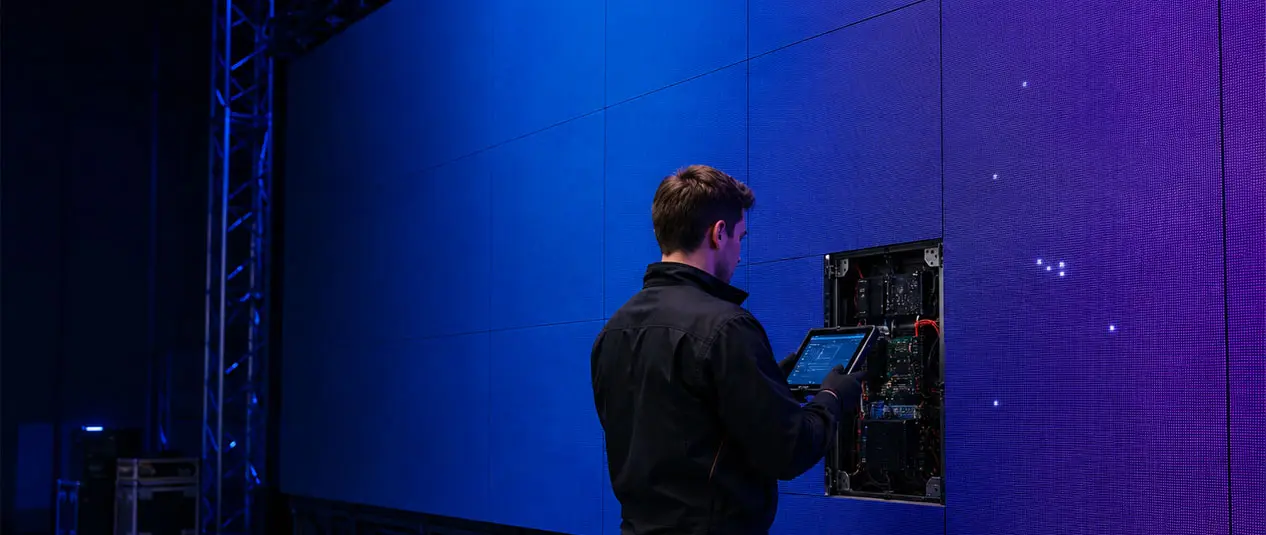
- Front or rear maintenance access
- Maximum and average power consumption
- Refresh rate and camera requirements
- Video processor input and output capacity
- Montado en la pared, floor-standing or suspended installation
- Spare modules and after-sales support
Providing these details allows the manufacturer to recommend a screen configuration that balances image quality, installation requirements and project budget.
Preguntas frecuentes
Is 1920 × 1080 always a 16:9 resolución?
Sí. Dividing 1920 por 1080 produces the same proportional relationship as 16 divided by 9. It is the standard Full HD 16:9 resolución.
Can an LED display be exactly 16:9?
Sí, but the physical dimensions, module size, cabinet arrangement and pixel resolution must be planned together. Not every cabinet combination produces an exact 16:9 screen.
What pixel pitch is best for a 16:9 Pantalla LED?
The correct pixel pitch depends mainly on viewing distance and resolution requirements. Meeting rooms may require P0.9–P1.8, while stages and outdoor events often use a larger pitch.
Can a 16:9 LED display show 4K content?
Sí. For native 4K playback, the screen should provide 3840 × 2160 physical pixels and use a compatible video processor. A lower-resolution screen can accept a 4K source, but the processor will scale it down.
How do I calculate the height of a 16:9 Pantalla LED?
Multiply the required width by 9 and divide by 16. Por ejemplo, an 8-meter-wide screen should be approximately 4.5 meters high.
Conclusión
Un 16:9 aspect ratio LED display provides strong compatibility with Full HD, 4K, presentation and video content. It is a practical choice for conferences, event stages, estudios de transmisión, classrooms and commercial environments.
For the best result, do not select the aspect ratio independently. Screen dimensions, paso de píxel, cabinet configuration, resolution and video processing must be engineered as one system.
LEDCHEER can provide modular and all-in-one LED display solutions based on your installation space, viewing distance and required resolution. Contact LEDCHEER to plan a suitable 16:9 LED display configuration.
