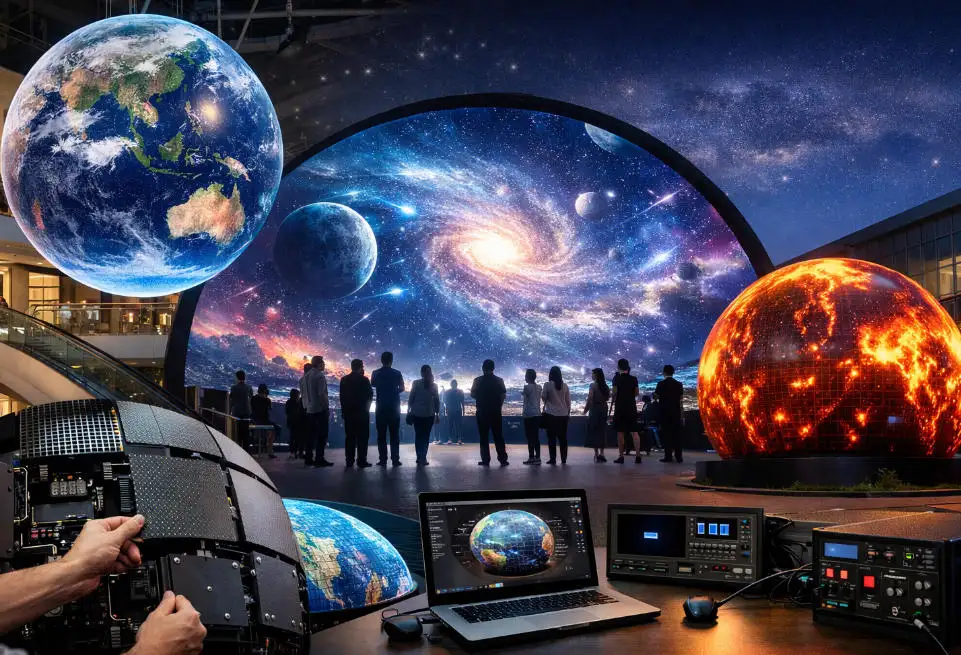
Sphere and Dome LED Displays: Engineering and Content Considerations
Innovative display technologies are reshaping how audiences experience digital content—moving far beyond traditional flat LED screens. Among the most striking developments are sphere and dome LED displays, capable of delivering immersive, 360° visuals that capture attention in retail environments, museums, attraction venues, corporate spaces, and public installations. These curved LED architectures require both specialized engineering approaches and content production strategies to unlock their full impact. This article explores the core engineering principles, structural challenges, content considerations, and practical applications of sphere and dome LED displays, with insights drawn from industry leaders such as Exploring LEDCheer: Revolutionizing Visual Experiences with Advanced LED Display Solutions. What Are Sphere and Dome LED Displays? Unlike conventional flat LED panels, sphere and dome LED displays use curved or fully spherical LED modules assembled into three-dimensional surfaces. The result is a 360° viewing experience—content wraps around a curved volume, offering panoramic visibility from every angle. Typical implementations include: Manufacturers like LEDCheer offer customizable sphere LED products that support seamless splicing, high refresh rates (e.g., 3840Hz for smooth motion), and customizable diameters for both indoor and outdoor applications. Engineering Challenges and Considerations Designing sphere and dome LED displays extends well beyond simply bending a panel. Engineers must account for several unique mechanical, electrical, and optical challenges: 1. Modular Curved Construction To form a smooth sphere or dome, LED modules are shaped in specific polygonal geometries (often trapezoidal or custom profiles) that fit together like a 3D puzzle. This modular design must ensure: Advanced engineering and quality control are critical to align modules with minimal visible seams and maintain consistent image quality across curvature. 2. Thermal Management Curved displays inherently have less surface area exposed relative to flat arrays, making heat dissipation management more complex. Effective solutions include: For outdoor spheres, such as those offered by LEDCheer with ...
Learn More