


2026-02-18



Innovative display technologies are reshaping how audiences experience digital content—moving far beyond traditional flat LED screens. Among the most striking developments are sphere and dome LED displays, capable of delivering immersive, 360° visuals that capture attention in retail environments, museums, attraction venues, corporate spaces, and public installations. These curved LED architectures require both specialized engineering approaches and content production strategies to unlock their full impact.
This article explores the core engineering principles, structural challenges, content considerations, and practical applications of sphere and dome LED displays, with insights drawn from industry leaders such as Exploring LEDCheer: Revolutionizing Visual Experiences with Advanced LED Display Solutions.
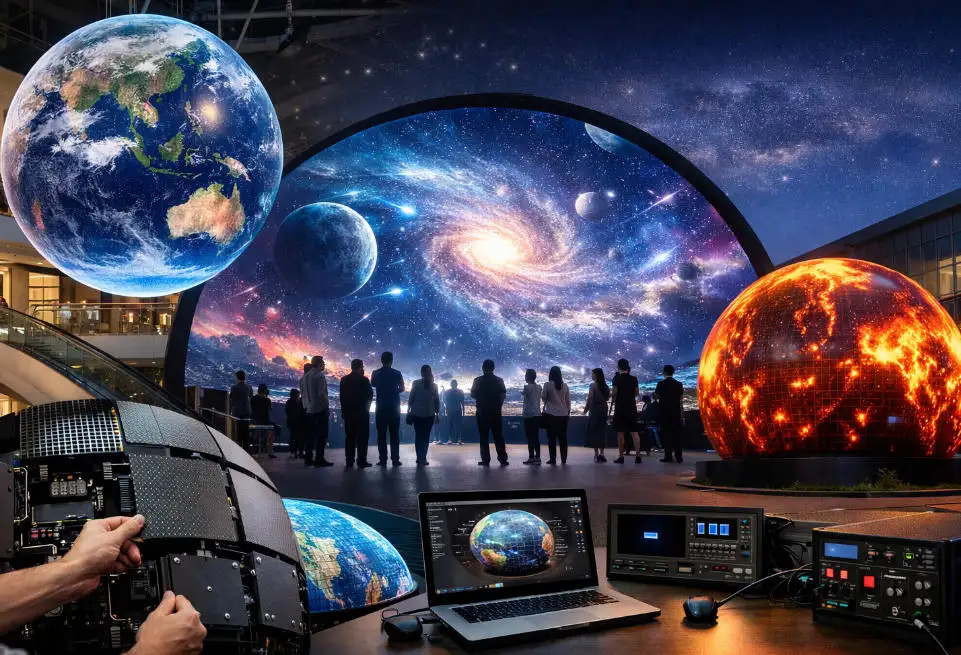
What Are Sphere and Dome LED Displays?
Unlike conventional flat LED panels, sphere and dome LED displays use curved or fully spherical LED modules assembled into three-dimensional surfaces. The result is a 360° viewing experience—content wraps around a curved volume, offering panoramic visibility from every angle. Typical implementations include:
- Full Spherical Displays — complete 360° spheres.
- Domed Displays — hemispherical or partial sphere-style installations.
- Partial Curved or Hybrid Geometry — combining flat panels with curvature for distinctive visual experiences.
Manufacturers like LEDCheer offer customizable sphere LED products that support seamless splicing, high refresh rates (e.g., 3840Hz for smooth motion), and customizable diameters for both indoor and outdoor applications.
Engineering Challenges and Considerations
Designing sphere and dome LED displays extends well beyond simply bending a panel. Engineers must account for several unique mechanical, electrical, and optical challenges:
1. Modular Curved Construction
To form a smooth sphere or dome, LED modules are shaped in specific polygonal geometries (often trapezoidal or custom profiles) that fit together like a 3D puzzle. This modular design must ensure:
- Seamless splicing without visual gaps or distortions.
- Accurate pixel mapping for uniform brightness and color across the surface.
- Flexible structural mounting options without compromising rigidity.
Advanced engineering and quality control are critical to align modules with minimal visible seams and maintain consistent image quality across curvature.
2. Thermal Management
Curved displays inherently have less surface area exposed relative to flat arrays, making heat dissipation management more complex. Effective solutions include:
- Aluminum structure heat sinks
- Design layouts that promote natural airflow
- Specialized materials or encapsulation solutions
For outdoor spheres, such as those offered by LEDCheer with IP67 waterproofing and protective silicone gel encapsulation, environmental sealing must coexist with thermal design to maintain durability and performance.
3. Structural Support and Mounting
Engineering reliable fixtures for sphere and dome LED installations demands precision. Depending on size and weight, displays may require:
- Internal support frameworks to evenly distribute load
- Suspension systems for overhead or atrium installations
- Floor stands for large freestanding spheres
- Customized mountings based on venue architecture
The right mechanical design ensures safety, stability, and ease of maintenance.
4. Power Delivery and Control Systems
A 360° LED structure increases electrical complexity:
- Segmented power distribution ensures consistent voltage across modules.
- Support for remote power control and synchronous content playback.
- Advanced control hardware to synchronize content without tearing or latency.
Innovative control platforms ensure high refresh rates and stable content delivery across the entire surface for visually fluid results.
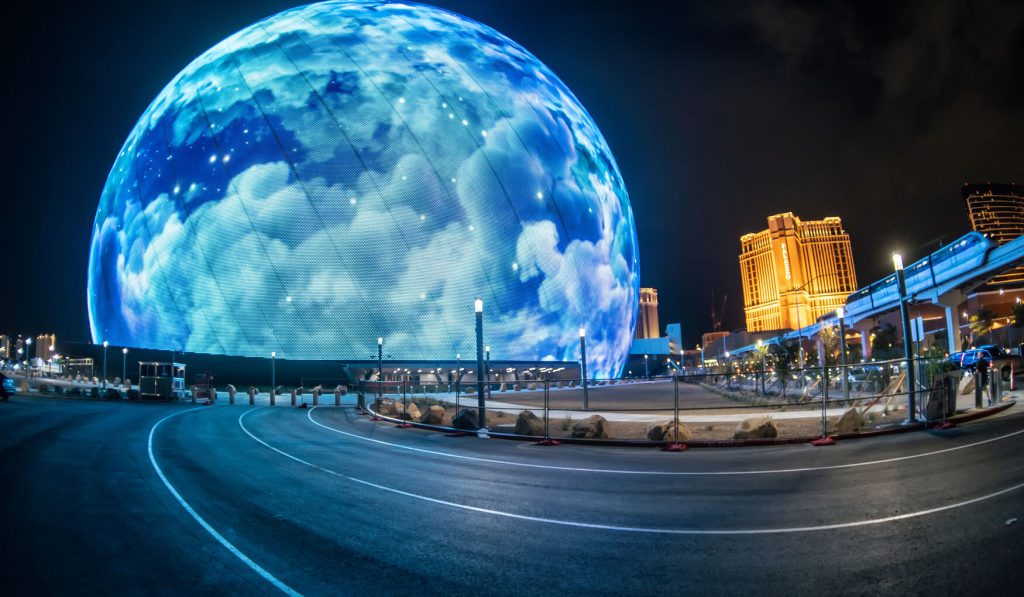
Content Strategy and Visual Planning
Sphere and dome LED installations demand specialized content creation approaches that differ significantly from flat display workflows.
1. Mapping Content to Curved Geometry
Standard 16:9 or square videos won’t map correctly on curved surfaces. Content teams must:
- Use spherical or equirectangular mapping techniques.
- Adjust for curvature distortions that occur with traditional flat content.
- Design content that flows across 360° without hard visual breaks.
Tools like 3D rendering software and custom LED mapping suites help producers generate visuals specifically for spherical or dome-shaped canvases.
2. Creating Immersive Experiences
Content for spherical displays should take advantage of all viewing angles:
- Panoramic visuals that engage users no matter where they stand.
- Use of layered elements and motion that envelops the viewer.
- Spatial audio and interactive triggers can enhance immersion.
Well-produced content makes these installations memorable and effective for branding, entertainment, or experiential engagements.
3. Audience-Focused Content Design
Consider viewing context and distance:
- High-resolution pixel pitches ensure clarity at close range.
- For larger venues, content may emphasize bold patterns, large typography, and high-contrast graphics that remain legible from afar.
- Interactive or live data feeds can make displays dynamic and relevant.
Gradient light, depth cues, and animated loops optimized for spherical orientation all enhance viewer engagement.
Real-World Applications
Sphere and dome LED displays are increasingly popular across industries:
- Retail and Shopping Centers: Suspended spheres draw attention to special events or seasonal campaigns.
- Exhibitions and Museums: Immersive storytelling, educational experiences, or art installations.
- Entertainment Venues: Domed ceilings at planetariums or themed attractions.
- Public Spaces and Landmarks: Large-scale spherical billboards or digital art pieces.
The seamless, panoramic nature of these displays helps brands and designers stand out in crowded visual markets.
Future Trends in Sphere and Dome Displays
Advancements in LED technology, including:
- Higher pixel density micro-LEDs
- Enhanced color uniformity algorithms
- AI-assisted content generation for curved surfaces
are all pushing the boundaries of what’s possible in immersive LED installations. These innovations contribute to both higher visual fidelity and more energy-efficient solutions.
Sphere and dome LED displays represent a new frontier in immersive visual technology. Their engineering requires sophisticated modular design, thermal and electrical planning, and integrated control systems. Equally important is a content strategy that respects curved geometry and maximizes engagement from every angle.
With advances from manufacturers like LEDCheer and industry partners driving innovation in creative shapes, seamless splicing, and robust performance, spherical LED installations are poised to define next-generation experiences across commercial, cultural, and entertainment environments.
