What is COB / GOB LED Technology — Benefits, Trade-offs, and Use Cases
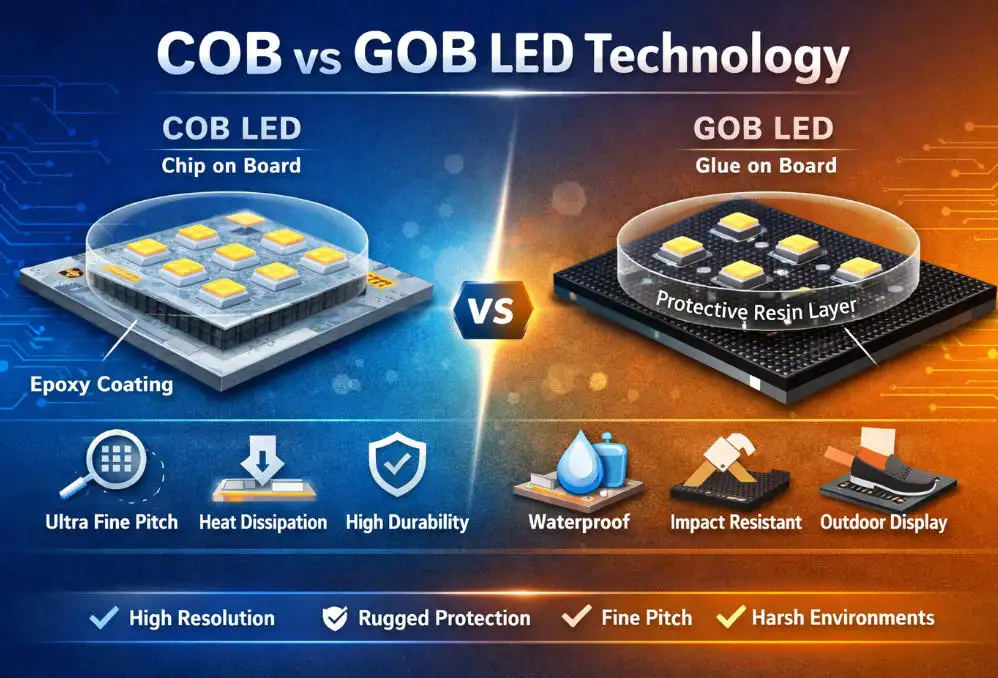
In the world of LED displays, packaging technology is a core determinant of performance, durability, and visual quality. Two advanced techniques that have reshaped LED display solutions — especially for fine-pitch and high-precision applications — are COB (Chip on Board) and GOB (Glue on Board) LED technologies. These innovations represent significant evolution from traditional SMD (Surface Mounted Device) LEDs, addressing limitations in pixel density, protection, and visual uniformity. Understanding the differences between COB and GOB, along with their respective advantages and trade-offs, is vital for choosing the right LED display solution for your project. Understanding COB LED Technology COB (Chip on Board) refers to a packaging process where multiple bare LED chips are mounted directly onto the PCB substrate and sealed with epoxy resin to form an integrated light-emitting surface. This structure eliminates traditional lamp housings, reducing gaps and creating a smooth, continuous light panel. According to LEDCheer’s product information, COB LED displays offer slim design, high contrast, low failure rates, and energy-efficient operation. Key Benefits of COB LED Trade-offs and Considerations While COB LED technology delivers professional-grade performance, it does have trade-offs: Understanding GOB LED Technology GOB (Glue on Board) is a protective enhancement technique applied to LED modules — typically based on SMD components — where a transparent layer of glue or resin is applied over the surface. This layer encapsulates the LED beads and solder joints, offering external protection without fully reengineering the LED packaging. Key Benefits of GOB LED Trade-offs and Considerations COB vs GOB LED: Side-by-Side Comparison Feature COB LED GOB LED Protection Excellent full-surface sealed protection Strong surface protection, especially against moisture & impacts Heat Dissipation Direct, efficient thermal path Slightly reduced due to protective layer Image Smoothness Very high, seamless surface Improved vs. bare SMD, but less smooth than COB Maintenance Module level ...
Learn More