



2026-03-04



In the world of LED displays, packaging technology is a core determinant of performance, durability, and visual quality. Two advanced techniques that have reshaped LED display solutions — especially for fine-pitch and high-precision applications — are COB (Chip on Board) and GOB (Glue on Board) LED technologies. These innovations represent significant evolution from traditional SMD (Surface Mounted Device) LEDs, addressing limitations in pixel density, protection, and visual uniformity. Understanding the differences between COB and GOB, along with their respective advantages and trade-offs, is vital for choosing the right LED display solution for your project.
Understanding COB LED Technology
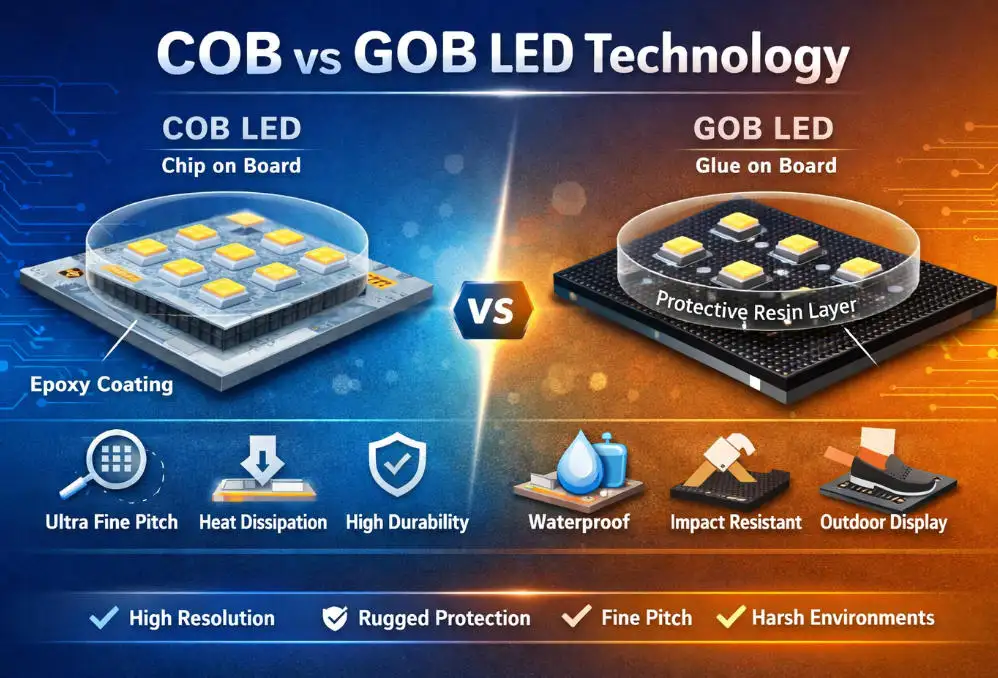
COB (Chip on Board) refers to a packaging process where multiple bare LED chips are mounted directly onto the PCB substrate and sealed with epoxy resin to form an integrated light-emitting surface. This structure eliminates traditional lamp housings, reducing gaps and creating a smooth, continuous light panel. According to LEDCheer’s product information, COB LED displays offer slim design, high contrast, low failure rates, and energy-efficient operation.
Key Benefits of COB LED
- Seamless Visual Experience: COB’s flat surface eliminates “dot” effects and reduces moiré patterns, delivering smoother, more uniform imagery — ideal for high-resolution indoor displays.
- Enhanced Durability: Encapsulation protects the LED chips from moisture, dust, and impact, making COB reliable for long-term installations.
- Superior Heat Dissipation: Direct chip-to-board mounting enhances thermal transfer, supporting stable operation and reduced power consumption — essential for 7×24 operation environments.
- Energy Efficiency & Longevity: COB LED modules often consume less power and retain high luminosity over longer lifespans, lowering long-term operational costs.
- Fine Pixel Pitch Capability: COB enables pixel pitches well below traditional SMD limits (e.g., P0.4–P0.6), making it suitable for close-up viewing applications likebroadcast studios or control rooms.
Trade-offs and Considerations
While COB LED technology delivers professional-grade performance, it does have trade-offs:
- Higher Manufacturing Complexity: The precision manufacturing and encapsulation make COB displays more expensive than conventional LED solutions.
- Maintenance Challenges: Individual LED chips are embedded and not serviceable on a per-pixel basis — module replacement is required if failures occur.
- Repair Costs: Specialized equipment and technical expertise are needed for repairs, increasing service costs and downtime.
Understanding GOB LED Technology
GOB (Glue on Board) is a protective enhancement technique applied to LED modules — typically based on SMD components — where a transparent layer of glue or resin is applied over the surface. This layer encapsulates the LED beads and solder joints, offering external protection without fully reengineering the LED packaging.
Key Benefits of GOB LED
- Robust Environmental Protection: GOB adds a protective surface layer that dramatically improves resistance to water, moisture, dust, and impacts. This makes GOB a popular choice for public, interactive, or high-traffic installations.
- Enhanced Structural Reliability: By securing component joints and surfaces, GOB reduces the risk of LED breakout or damage from external forces.
- Improved Visual Uniformity: While still based on discrete LEDs, the glue coating reduces glare and diffraction, improving perceived image smoothness.
- Lower Maintenance Than Raw SMD: Compared with bare SMD panels, GOB technology reduces dead-pixel risk, although individual LED repair remains challenging.
Trade-offs and Considerations
- Slightly Reduced Heat Dissipation: The glue coating can marginally restrict thermal transfer compared to direct PCB contact in COB designs.
- Repair Limitations: Like COB, GOB panels are difficult to repair at the individual LED level once epoxy encapsulation is applied.
- Optical Trade-offs: The additional optical layer may introduce internal reflections, potentially affecting contrast in extreme precision applications.
COB vs GOB LED: Side-by-Side Comparison
| Feature | COB LED | GOB LED |
|---|---|---|
| Protection | Excellent full-surface sealed protection | Strong surface protection, especially against moisture & impacts |
| Heat Dissipation | Direct, efficient thermal path | Slightly reduced due to protective layer |
| Image Smoothness | Very high, seamless surface | Improved vs. bare SMD, but less smooth than COB |
| Maintenance | Module level only — higher cost | Harder than SMD, easier than COB |
| Cost | Typically higher upfront | Lower than COB but higher than bare SMD |
| Ideal For | High-end indoor/precision | Outdoor signage, high-traffic environments |
This direct comparison helps designers and procurement teams choose based on performance vs. practical deployment constraints.
Typical Use Cases
COB LED Displays
- Broadcast and TV studios
- Control rooms and government command centers
- Corporate boardrooms and conference walls
- High-end retail and experiential media walls
- Indoor installations where fine detail is critical
GOB LED Displays
- Outdoor advertising and DOOH installations
- Stadium LED displays and sports scoreboard panels
- Interactive digital floor and wall tiles
- Retail and public signage with frequent physical contact
- Environments needing rugged durability with high reliability
Practical Tips for Selection
- Define Viewing Distance: For ultra-close viewing (e.g., under 2 m), COB is often preferable due to finer pixel pitch potential.
- Consider Operating Environment: Harsh or outdoor environments typically benefit from GOB’s water and dust resistance.
- Budget & Maintenance: Balance upfront cost vs. lifecycle maintenance — COB may have higher initial cost but lower long-term failure rates.
- Brightness and Contrast Needs: For applications like broadcast studios or exhibition halls requiring top-tier color uniformity and contrast, COB is often superior.
Both COB and GOB LED technologies represent meaningful advancements over traditional LED packaging systems, giving manufacturers and installers powerful tools for solving specific display challenges. COB shines in high-resolution, indoor precision use, delivering uniform light, deep contrast, and energy-efficient operation. GOB excels in ruggedized, environmental-exposed environments, offering strong protection and reliable long-term performance.
Selecting between COB and GOB hinges on understanding your use case, environmental needs, budget constraints, and visual quality expectations. With innovations continuing in both domains, choosing the right LED technology today can future-proof displays for years of operation.
