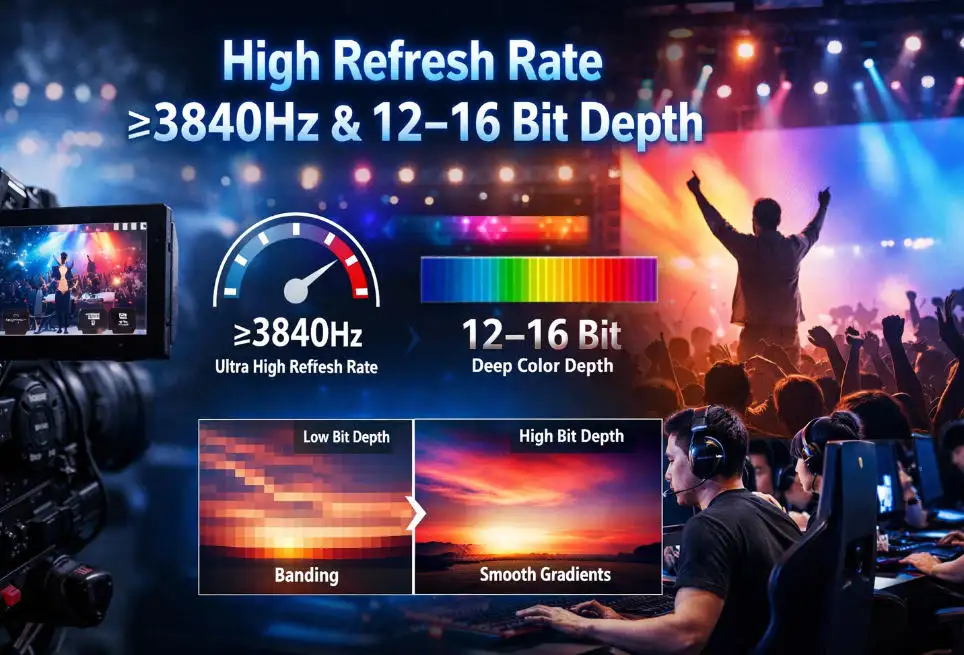
High Refresh Rates and Bit Depth: Why ≥3840Hz and 12–16-Bit Matter for Live Broadcast
In the world of live broadcast, visual quality isn’t merely about resolution — it’s about how smoothly and accurately content appears both to the human eye and to cameras capturing that content. For applications like TV studios, stage shows, concerts, esports events, and digital signage with live recording, LED displays must meet rigorous specifications to deliver broadcast-ready visuals. Two key parameters that determine this performance are refresh rate and bit depth. At its core, refresh rate and bit depth are technical specs, but in professional live broadcast environments, they are fundamental to ensuring flicker-free, lifelike imagery with precise color reproduction — and failure to meet these criteria can result in distracting artifacts such as scanning lines, banding, or loss of detail during dynamic scenes. This article explains why a minimum of ≥3840 Hz refresh rate and 12–16-bit bit depth have become benchmarks for modern broadcast-grade LED displays — and how these specifications directly impact content quality and camera compatibility. What Refresh Rate Really Means for LED Displays In LED terminology, refresh rate refers to how many times per second the display renews its LED output signal — effectively how often it redraws each pixel. Unlike consumer TVs that refresh at 60–120 Hz, professional LED video walls often use refresh rates of ≥3840 Hz or higher. This ultra-fast updating is essential for live broadcast applications where cameras with varying shutter speeds film the LED content. Why ≥3840 Hz Matters Understanding Bit Depth and Its Importance While refresh rate dictates temporal stability, bit depth governs how smoothly a display can represent brightness and color gradations. Bit depth indicates the number of distinct brightness levels a pixel can produce. For example: Why 12–16-Bit Depth Matters in Broadcast How Higher Refresh & Bit Depth Work Together The benefits of high refresh rates and bit ...
Learn More