


2026-02-20



In the world of live broadcast, visual quality isn’t merely about resolution — it’s about how smoothly and accurately content appears both to the human eye and to cameras capturing that content. For applications like TV studios, stage shows, concerts, esports events, and digital signage with live recording, LED displays must meet rigorous specifications to deliver broadcast-ready visuals. Two key parameters that determine this performance are refresh rate and bit depth.
At its core, refresh rate and bit depth are technical specs, but in professional live broadcast environments, they are fundamental to ensuring flicker-free, lifelike imagery with precise color reproduction — and failure to meet these criteria can result in distracting artifacts such as scanning lines, banding, or loss of detail during dynamic scenes.
This article explains why a minimum of ≥3840 Hz refresh rate and 12–16-bit bit depth have become benchmarks for modern broadcast-grade LED displays — and how these specifications directly impact content quality and camera compatibility.
What Refresh Rate Really Means for LED Displays
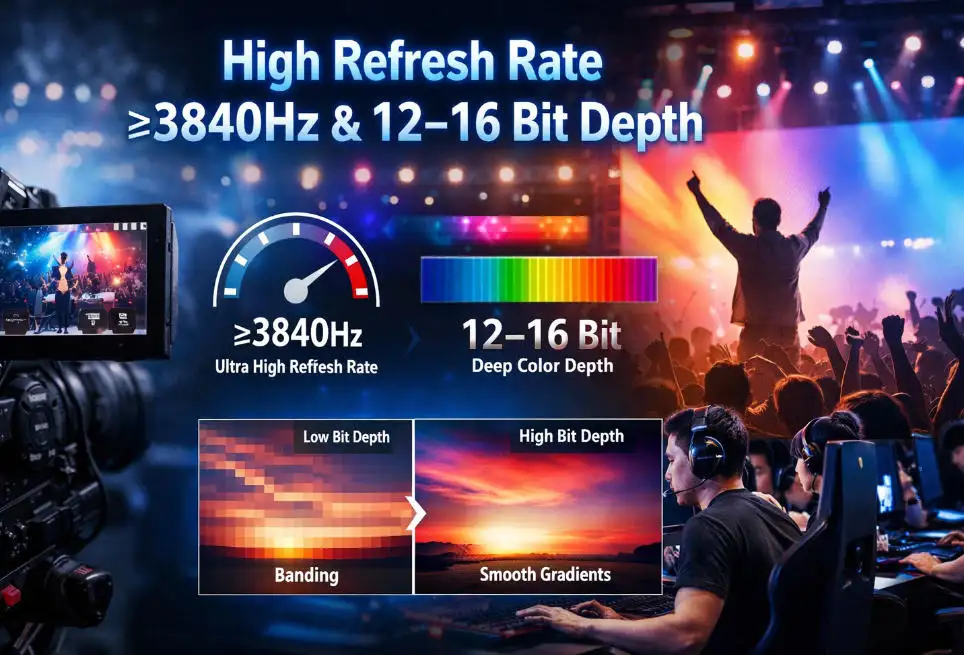
In LED terminology, refresh rate refers to how many times per second the display renews its LED output signal — effectively how often it redraws each pixel. Unlike consumer TVs that refresh at 60–120 Hz, professional LED video walls often use refresh rates of ≥3840 Hz or higher. This ultra-fast updating is essential for live broadcast applications where cameras with varying shutter speeds film the LED content.
Why ≥3840 Hz Matters
- Eliminates Visible Flicker on Camera
- A display with lower refresh (e.g., 960–1920 Hz) may appear stable to the naked eye, but cameras — especially high-speed or broadcast cameras — often capture flicker or distracting horizontal scan lines unless the LED refresh rate is significantly higher than the camera’s frame rate. Refresh rates of ≥3840 Hz ensure enough refresh cycles per frame to avoid visible artifacts in recorded footage.
- Motion Clarity and Smoothness
- High refresh rates reduce motion blur during on-screen movement, providing fluid visuals for fast-paced content such as sports, dance, and camera pans. Lower refresh can introduce stutter or ghosting in fast sequences.
- Camera Compatibility
- Live broadcasts often use multiple cameras with different shutter speeds. A refresh rate of ≥3840 Hz helps ensure consistency across cameras and avoids line flicker or rolling bars that can occur when refresh and shutter sync mismatch.
- Professional Broadcast Standard
- Industry engineering guidelines recommend ≥3840 Hz as the baseline for broadcast applications, while more demanding environments (XR, virtual production) may require ≥7680 Hz.
Understanding Bit Depth and Its Importance
While refresh rate dictates temporal stability, bit depth governs how smoothly a display can represent brightness and color gradations. Bit depth indicates the number of distinct brightness levels a pixel can produce. For example:
- 8-bit depth: 256 levels per color channel
- 12-bit depth: 4096 levels per channel
- 16-bit depth: 65,536 levels per channel
Why 12–16-Bit Depth Matters in Broadcast
- Smooth Gradients & No Banding
- Higher bit depth delivers more granular color transitions and eliminates “banding” — a common artifact in low-bit systems where subtle gradients (like skies or shadows) appear as visible steps instead of smooth transitions. This is especially important in broadcast footage, where content is scrutinized on large screens.
- Enhanced Detail in Highlights & Shadows
- A deeper bit depth improves how well a display reproduces subtle tonal variations — darker shadows, soft highlights, or nuanced midtones — preserving detail in complex scenes.
- Better HDR Rendering
- High dynamic range (HDR) content demands greater bit depth to represent extended brightness ranges without quantization errors. HDR is becoming standard in broadcast workflows, making 12-16-bit even more relevant.
- Avoiding Posterization
- Low bit depth can cause visible jumps in color and brightness — a phenomenon known as posterization. Higher bit depths virtually eliminate this, contributing to richer, more cinematic visuals.
How Higher Refresh & Bit Depth Work Together
The benefits of high refresh rates and bit depth are interdependent:
- A high bit depth demands a stable, flicker-free refresh cycle to display precise gradations without visual defects.
- Conversely, a high refresh rate without sufficient bit depth can still result in color banding or poor gradation, undermining broadcast quality.
Systems designed for live broadcast typically combine ≥3840 Hz refresh with 12–16-bit processing to ensure a clear, stable, dynamic image that performs well both to the human viewer and on camera.
CheerLED’s Approach to Broadcast-Grade LED Displays
Manufacturers such as CheerLED LED Display Solutions emphasize LED display products that meet professional refresh and bit depth requirements. Their product range — including rental & stage LED displays, commercial LED walls, and creative shape displays — often features:
- High refresh rates (≥3840 Hz) suitable for broadcast recording and live events,
- High colour bit processing (12–16-bit) for smooth visual gradation,
- Customizable solutions for stage, DOOH, XR, and creative LED installations,
- Engineering support for high-end broadcast and event production scenarios.
These capabilities align with industry expectations that LED walls in professional environments must deliver both temporal and color fidelity to ensure that live footage is free from flicker, scanning artifacts, and color inaccuracies.
Real-World Broadcast Benefits
Here’s how these technical advantages translate in practice:
Studio Sets & Virtual Production
A VJ or camera operator expects visuals that don’t interfere with live capture — which means no flicker, no artifact lines, and no abrupt tonal shifts — all of which high refresh and bit depth specs help achieve.
Live Concerts & Stage Events
LED backgrounds or video walls must display dynamic content in sync with performers and lighting. Low refresh rates cause strobing or ghosting when recorded, while shallow bit depth loses detail during rapid brightness changes.
Sport Broadcasting & Esports
In sports or gaming broadcasts, every millisecond counts. High refresh assures that motion is crisp and fluid, and high bit depth ensures consistent color even with sports balls, fast players, and rapid camera panning.
For live broadcast environments where cameras and audiences demand professional-grade imagery, refresh rates of ≥3840 Hz combined with 12–16-bit bit depth aren’t just selling points — they are technical necessities. These specs ensure:
- Flicker-free filming
- Smooth motion and clarity
- Accurate color reproduction
- Broadcast-ready visuals under diverse lighting conditions
Whether you’re producing TV studio backdrops, live concert visuals, immersive brand experiences, or large-venue digital signage, choosing LED displays with strong refresh and high bit depth will future-proof your content quality and maximize audience impact — making your visual presentation truly broadcast-ready.
