


* THERE ARE 76 ARTICLES
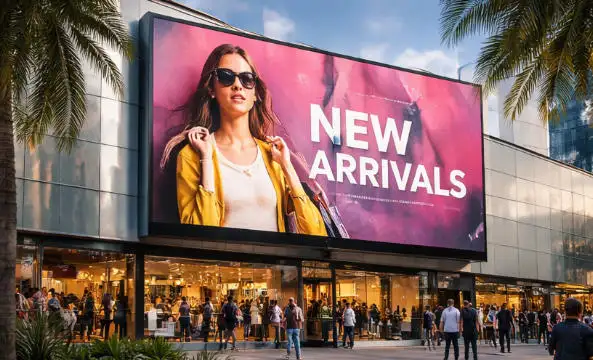
The Rise of DOOH Advertising: What Brands Are Really Getting Into
- # DOOH advertising
- # outdoor LED advertising screens
Walk through any major city today and you’ll notice something has quietly changed. Billboards aren’t static anymore. They move. They react. They feel… alive. This is DOOH advertising (digital out-of-home advertising)—and it’s not just a trend. It’s quickly becoming one of the most practical ways for brands to cut through the noise. I’ve worked around LED display projects and outdoor advertising systems long enough to see the shift happen in real time. What used to be a simple “put your logo on a billboard” game has turned into something far more strategic—and far more interesting. DOOH Isn’t Just Digital Billboards. It’s a Different Mindset. A lot of people still confuse digital out-of-home advertising with traditional OOH plus a screen. That’s not what’s happening. DOOH combines: A campaign can now change based on weather, time of day, or even traffic flow. That alone reshapes how brands think about visibility. And when you connect that with mobile retargeting or social media, DOOH stops being “offline advertising.” It becomes part of a full digital loop. Why Brands Are Putting More Budget Into DOOH There’s a reason DOOH marketing trends in 2025 keep pointing upward. 1. You Can’t Scroll Past It Online ads are easy to ignore. People skip, block, or scroll. A well-placed LED billboard advertising screen, though? You’re going to see it. That kind of forced visibility still matters—especially for brand awareness. 2. It Feels More Legit There’s an unspoken rule in marketing: If a brand shows up on a massive outdoor screen in a prime location, people take it more seriously. Compared to banner ads, digital billboard advertising carries weight. It signals scale. 3. Programmatic DOOH Is Catching Up Fast One of the biggest changes I’ve seen is the rise of programmatic DOOH. Media buyers can now: It’s starting to behave ...
By Cheer
2026-03-30
2026-03-30
How to Choose an LED Supplier: Factory Capabilities, Customization & OEM/ODM Options
- # LED display manufacturer
- # rental LED display manufacturer
Choosing the right LED display supplier is not just about price—it’s about long-term reliability, scalability, and technical partnership. Whether you are sourcing for rental LED screens, DOOH advertising, or commercial installations, the supplier you select will directly impact your project quality, maintenance costs, and brand reputation. This guide breaks down how to evaluate LED suppliers from three critical dimensions: factory capabilities, customization flexibility, and OEM/ODM expertise, while incorporating real-world insights from leading manufacturers such as CheerLED. 1. Factory Capabilities: The Foundation of a Reliable LED Supplier A supplier’s factory strength determines product consistency, delivery timelines, and quality control. 1.1 Production Scale & Automation Top-tier LED manufacturers operate automated production lines and large-scale facilities. For example, some factories in Shenzhen exceed 8,000㎡ production areas with automated assembly systems, ensuring precision and stable output. What to look for: 👉 Why it matters: Higher automation = fewer defects and faster delivery. 1.2 R&D Capability and Innovation A strong R&D team is a key differentiator. Leading suppliers invest heavily in: For instance, CheerLED emphasizes continuous innovation and dedicated R&D teams to stay ahead of LED technology trends. Key indicators: 1.3 Quality Control System (QC) Reliable suppliers implement strict QC processes such as: Manufacturers like CheerLED highlight rigorous QC systems and strict production techniques to ensure high standards. 👉 Red flag: Suppliers without documented QC procedures or certifications. 1.4 Supply Chain Integration Strong factories control: Some suppliers maintain long-term partnerships with key component brands, ensuring stable performance and compatibility. 2. Customization Capabilities: Meeting Real Project Needs Modern LED projects are rarely standard. Customization is no longer optional—it’s essential. 2.1 Product Customization Scope A professional supplier should offer: For example, CheerLED provides fully customized LED displays in size, shape, material, and resolution, including creative forms like spheres and flexible modules. 2.2 Application-Based Solutions Top suppliers don’t ...
By Cheer
2026-03-29
2026-03-29
All-in-One LED Displays: What Actually Matters (From Someone Who’s Seen Too Many Installs Go Wrong)
- # all-in-one LED display
- # OEM all-in-one LED display
I’ve watched enough LED projects fall apart on-site to know one thing: the problem is rarely the screen itself. It’s the install. The wiring. The endless calibration. The last-minute surprises no one budgeted for. That’s exactly where all-in-one LED displays change the game. They’re not just a new product category. They’re a correction. A response to years of overcomplicated LED video wall solutions that looked great on paper and turned into a headache in real life. If you’re evaluating an integrated LED display system—whether for a meeting room, showroom, or commercial deployment—this is what actually matters. What Is an All-in-One LED Display (And Why It Exists) Strip away the marketing language, and it’s simple. An all-in-one LED display is a fully integrated LED display system where: …are already built into a single unit. No external boxes. No rack cabinets. No spaghetti wiring behind the wall. I like to describe it this way: A traditional LED wall is a construction project.An all-in-one LED display is a finished product. That difference alone is why more buyers are searching for terms like: They’re not just looking for better visuals. They’re looking for fewer problems. The Features That Actually Make a Difference 1. Real Integration (Not Just Marketing Talk) A lot of products claim to be “integrated.” Few actually are. With a proper all-in-one LED display, integration means: From what I’ve seen, this is where companies like LEDCHEER have focused their engineering—pushing high integration so the system behaves more like a single device, not a collection of parts. The payoff is obvious the moment you turn it on: it just works. 2. Plug-and-Play Isn’t a Buzzword—It’s a Time Saver I’m naturally skeptical of anything labeled “plug and play.” In LED, that phrase used to be a stretch. Here, it’s mostly accurate. You’re typically dealing ...
By Cheer
2026-03-27
2026-03-27
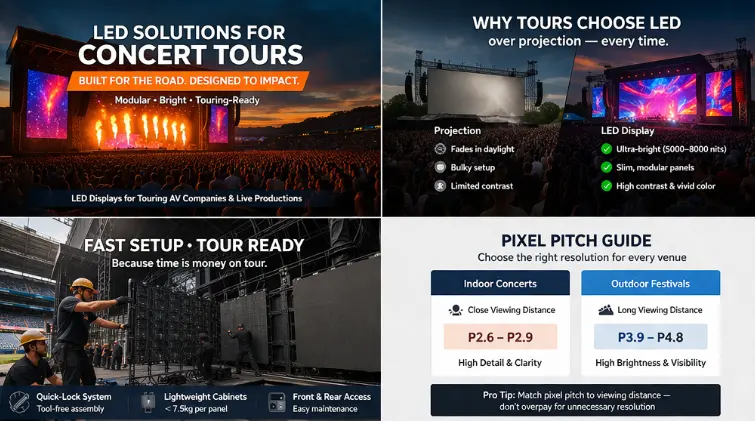
LED Solutions for Concert Tours and Touring AV Companies
- # LED Displays
Introduction: Life on Tour Isn’t Easy—Your LED System Should Be If you’ve ever worked on a concert tour, you already know—nothing about it is static. One night you’re in a packed indoor arena, the next you’re dealing with wind, dust, and unpredictable weather at an outdoor festival. Everything moves fast. Load in, set up, rehearse, perform, tear down, and do it all over again in a new city. In that kind of environment, your LED display system can’t just “look good.” It has to work flawlessly, every single time. That’s why more touring AV companies are moving toward modular, rental-focused LED solutions—systems designed not just for performance, but for life on the road. Manufacturers like LEDcheer have built their products around this reality, focusing on durability, speed, and flexibility rather than just specs on paper. Why LED Has Become the Backbone of Concert Touring A few years ago, projection still had its place. Today, LED has taken over—and for good reason. It Performs Anywhere, Anytime Imagine trying to run visuals at an outdoor festival in full daylight. Projection struggles. LED doesn’t. Modern LED displays deliver the kind of brightness and contrast that cuts through ambient light effortlessly. Whether it’s a daytime set or a night show with heavy lighting effects, your visuals stay sharp and vibrant. And if your show is being filmed or livestreamed? High refresh rates mean no flicker, no weird camera artifacts—just clean, professional output. It Adapts to Creative Vision Every tour has its own identity. Some want massive flat walls. Others want curved stages, immersive tunnels, or completely custom shapes. This is where modular LED systems really shine. With the right panels, your team can build: LEDcheer’s rental systems, for example, are built with flexibility in mind—so designers aren’t limited by the hardware. Speed Matters More ...
By Cheer
2026-03-24
2026-03-24
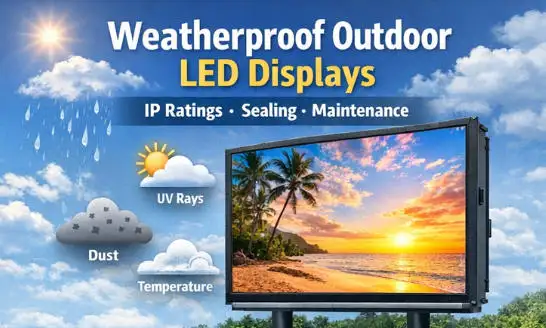
Weatherproofing Outdoor LED Displays: IP Ratings, Sealing Technologies, and Long-Term Maintenance
- # IP65 LED display
- # outdoor LED screen waterproof
- # weatherproof outdoor LED display
Outdoor LED displays operate in some of the harshest environments—exposed to rain, dust, UV radiation, humidity, and temperature fluctuations. Without proper weatherproofing, even high-end LED screens can suffer from corrosion, short circuits, brightness degradation, and premature failure. For manufacturers and buyers alike, understanding IP ratings, sealing structures, and long-term care strategies is critical to ensuring durability, reliability, and ROI. Leading manufacturers such as LEDCHEER incorporate advanced waterproofing and structural engineering to meet global outdoor application demands. This article provides a comprehensive technical guide to help you select, install, and maintain weatherproof outdoor LED displays effectively. 1. Understanding IP Ratings in Outdoor LED Displays 1.1 What is an IP Rating? IP (Ingress Protection) rating is an international standard (IEC 60529) used to define how well an enclosure protects against solid particles and liquids. An IP rating consists of two digits: For example: This makes IP65 the baseline standard for outdoor LED displays. 1.2 Common IP Ratings for LED Displays Rating Protection Level Application IP54 Splash & partial dust protection Semi-outdoor IP65 Dust-tight + rain/water jets Standard outdoor IP66 Strong water jets Harsh weather zones IP67 Temporary immersion Flood-prone areas IP68 Continuous immersion Extreme environments Outdoor LED displays typically require IP65 or higher to ensure stable performance. 1.3 Why IP Ratings Matter A higher IP rating directly impacts: Without adequate protection, dust and moisture can penetrate the cabinet, leading to electrical failure and corrosion over time. 2. Core Weatherproofing Technologies Modern outdoor LED displays rely on multiple layers of protection—not just IP rating labels. 2.1 Sealed Cabinet Design The cabinet is the first line of defense. High-quality outdoor displays use: Sealed cabinets prevent environmental ingress while maintaining structural integrity. 2.2 Gaskets and Sealants Gaskets play a critical role in sealing gaps between components. Key materials include: These materials: 2.3 Sealed Connectors and ...
By Cheer
2026-03-21
2026-03-21
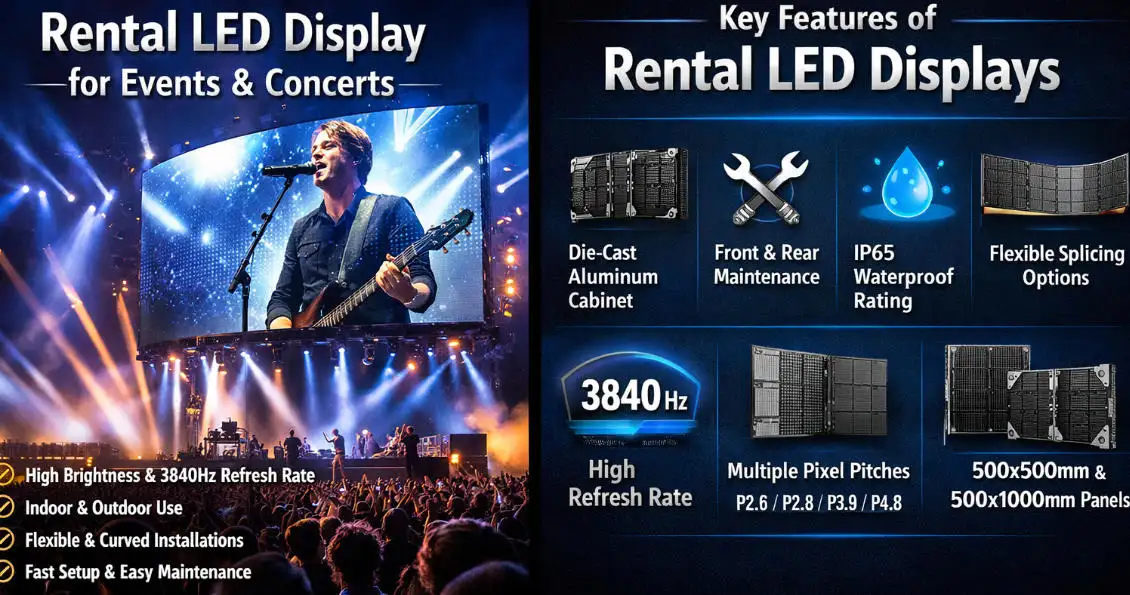
Indoor and Outdoor Rental LED Display: A Complete Guide for Event Professionals
- # indoor and outdoor rental LED display
- # rental LED screen for events
In today’s event industry, visual impact is everything. Whether it’s a live concert, corporate event, exhibition, or stage performance, the quality of your display can define the entire audience experience. This is where an indoor and outdoor rental LED display becomes essential. Unlike traditional screens, modern rental LED displays are designed for flexibility, durability, and high-performance visuals. They are built to handle frequent installation and dismantling while delivering stunning image quality in both indoor and outdoor environments. This guide explores everything you need to know—from key features and technical advantages to real-world applications—so you can choose the right rental LED screen for events and maximize your return on investment. Why Rental LED Displays Are Dominating the Event Industry Over the past decade, LED display technology has rapidly replaced projectors and LCD video walls in large-scale events. The reasons are clear. First, LED displays offer superior brightness and visibility. Outdoor environments, especially, demand screens that can compete with sunlight. With brightness levels reaching up to 4500 cd/m², modern outdoor LED displays for concerts ensure clear visuals even in daylight. Second, they provide seamless modular construction. Unlike traditional displays, LED panels can be assembled into virtually any size or shape. This flexibility makes them ideal for creative stage design. Finally, rental LED displays are engineered for mobility. Lightweight materials, quick-lock systems, and modular panels allow for fast setup and teardown—critical for event companies managing tight schedules. Key Features of Indoor and Outdoor Rental LED Displays 1. Flexible Pixel Pitch Options One of the most important factors in choosing an LED display is pixel pitch. Rental LED displays typically offer multiple options such as: This flexibility allows event planners to match screen resolution with audience distance, ensuring optimal image clarity without overspending. For example: 2. High Refresh Rate for Smooth Visuals A high ...
By Cheer
2026-03-19
2026-03-19
