


2026-03-15



As COB (Chip-on-Board) LED display technology continues to gain traction in high-end visual applications—such as control rooms, broadcast studios, conference centers, and retail displays—installation and maintenance methods have become an important decision factor for integrators and contractors.
Two major service architectures dominate the LED display industry: front-maintenance and back-maintenance systems. While both designs allow technicians to access internal components for repair or replacement, they differ significantly in installation flexibility, maintenance efficiency, structural requirements, and long-term operating costs.
For installers planning a COB LED display project, understanding these differences can help ensure smoother installations, reduced downtime, and optimized total cost of ownership.
This guide explains how front-maintenance and back-maintenance COB LED displays work, compares their advantages and limitations, and highlights the key considerations installers should evaluate before choosing a system.
Understanding COB LED Display Technology
COB (Chip-on-Board) technology directly encapsulates multiple LED chips onto a PCB substrate, creating a protective, integrated light-emitting surface. Compared with traditional SMD packaging, COB displays offer:
- Higher durability and pixel protection
- Improved heat dissipation
- Reduced risk of pixel damage
- Better environmental resistance
The encapsulated structure also allows many modern COB panels to support front-service designs, enabling module replacement from the viewing side of the screen.
This capability is particularly valuable for space-constrained installations, where maintaining rear service access is impractical.
What Is Front-Maintenance in COB LED Displays?
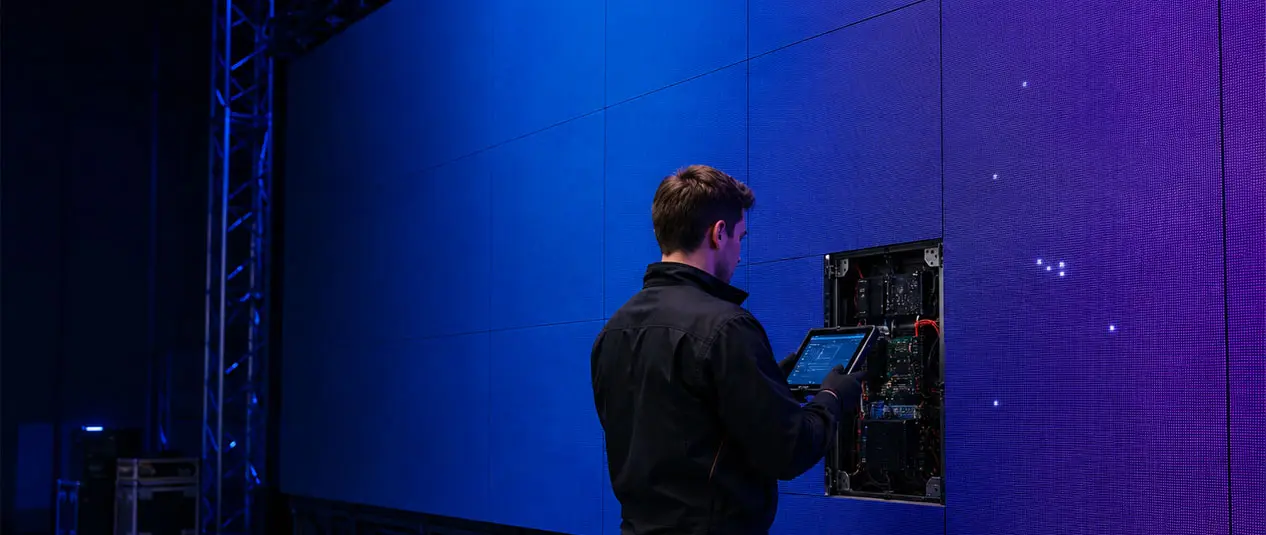
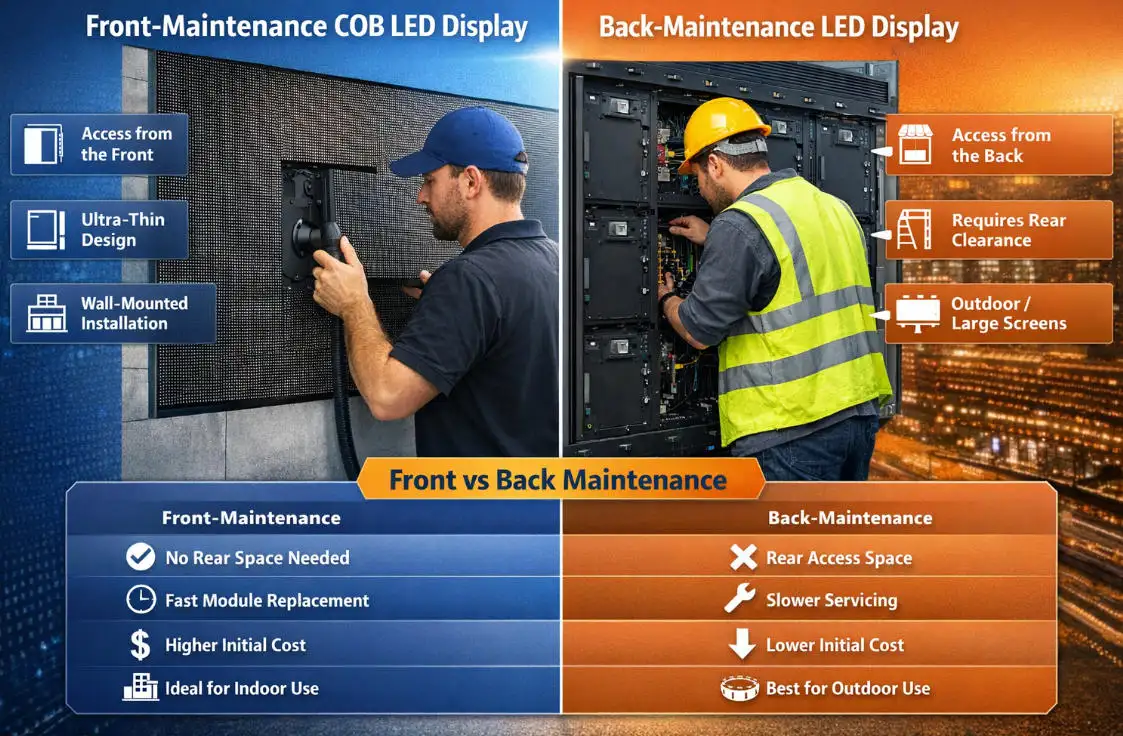
A front-maintenance LED display allows technicians to service key components—including LED modules, receiving cards, and power supplies—from the front side of the screen.
Modules are typically fixed using magnetic mounts, quick-release locks, or suction-tool access points, enabling a technician to remove a panel within minutes.
Key Characteristics
- Service access from the display surface
- Ultra-thin cabinet structures
- No rear service corridor required
- Faster module replacement
In many designs, installers can mount the display directly against a wall or architectural structure because maintenance does not require rear clearance.
Advantages for Installers
1. Space-Saving Installation
Front-service displays eliminate the need for a maintenance channel behind the screen, which is especially beneficial for wall-mounted installations in shopping malls, conference halls, and control rooms.
2. Faster Maintenance
Technicians can remove faulty modules quickly without dismantling surrounding panels or accessing the rear structure.
3. Reduced Labor Costs
Most front-service repairs can be completed by a single technician, lowering maintenance costs and minimizing downtime.
4. Better Architectural Integration
Thin cabinet designs allow the display to blend seamlessly with interior environments and modern building designs.
What Is Back-Maintenance in LED Displays?
Back-maintenance (rear-service) displays require technicians to access the internal components from the back of the LED wall.
This traditional design has been widely used in large outdoor displays, stadium screens, and billboard systems.
Key Characteristics
- Service access from the rear of the cabinet
- Thicker cabinet structures
- Requires dedicated maintenance corridor
- Simple mechanical design
Rear-service displays usually require 60–100 cm of space behind the screen so technicians can reach modules, power supplies, and signal components.
Advantages for Installers
1. Lower Initial Hardware Cost
Rear-service cabinets typically use simpler structures, making them more cost-effective to manufacture.
2. Strong Structural Durability
They are often used for large outdoor displays, where rugged construction and weather resistance are priorities.
3. Easier Heat Management
Rear-access cabinets often allow more airflow and easier cooling configuration.
Front vs Back Maintenance: Key Technical Differences
| Feature | Front-Maintenance COB LED | Back-Maintenance LED |
|---|---|---|
| Service access | From the front surface | From the back of the screen |
| Space requirement | No rear clearance needed | Requires maintenance corridor |
| Installation type | Wall-mounted, embedded | Freestanding or outdoor structures |
| Cabinet thickness | Ultra-thin | Thicker cabinet |
| Maintenance speed | Fast module replacement | Slower depending on access |
| Initial cost | Slightly higher | Usually lower |
| Typical applications | Indoor displays, command centers | Outdoor billboards, stadiums |
Front-service systems provide greater installation flexibility, while rear-service systems remain practical for large outdoor screens with ample maintenance space.
Why COB Displays Are Often Designed for Front Maintenance
COB LED technology naturally supports front-maintenance designs due to its integrated encapsulation and modular construction.
Key reasons include:
1. Protection of LED Chips
COB encapsulation protects LED chips beneath a durable surface layer, reducing damage risks during handling or maintenance.
2. High-Density Pixel Applications
Small pixel pitch displays used in command centers or conference rooms often require precise alignment and frequent servicing.
Front access simplifies these adjustments.
3. Space-Constrained Environments
Many modern installations—such as control rooms and retail displays—have limited depth behind the screen.
Front service allows the display to be installed flush against the wall.
Installation Scenarios: Which Maintenance Method Is Better?
Choose Front-Maintenance COB LED Displays When:
- The display is wall-mounted
- There is limited installation depth
- Fast service response is critical
- The display is located in indoor environments
Typical projects include:
- Retail digital signage
- corporate meeting rooms
- control room video walls
- broadcast studios
- exhibition halls
Manufacturers such as LED display suppliers often design COB fine-pitch video walls specifically for these professional indoor environments, where maintenance accessibility and aesthetics are equally important.
Choose Back-Maintenance Displays When:
- The display is large outdoor signage
- There is ample space behind the structure
- Installation involves billboards or stadium screens
- Initial budget is the primary consideration
These systems remain common for:
- roadside advertising screens
- sports arenas
- large-scale outdoor media façades
Installation Tips for LED Display Integrators
Before selecting a maintenance architecture, installers should evaluate the following factors:
1. Structural Space
Confirm whether the installation site allows rear access clearance.
If space is limited, front-service cabinets are usually the only viable solution.
2. Maintenance Frequency
High-resolution indoor displays often require more frequent calibration and maintenance, making front service more practical.
3. Installation Height
For high-elevation installations, front access may improve safety by eliminating the need for technicians to climb behind the display.
4. Cooling Design
Front-service cabinets must ensure proper airflow and heat dissipation due to their thinner structure.
5. Long-Term Maintenance Cost
Although front-service displays may have a higher initial cost, they often reduce labor time and operational downtime over the product lifecycle.
Future Trends: Front-Service COB Displays
The LED display industry is moving toward front-service architectures, especially for fine-pitch COB displays used in professional indoor applications.
Advancements in cabinet design, magnetic mounting systems, and modular power components are making front maintenance:
- Faster
- safer
- more installer-friendly
As COB technology continues to evolve, many manufacturers are integrating full front-service access for modules, power supplies, and signal cards, enabling even large video walls to be serviced entirely from the front.
Choosing between front-maintenance and back-maintenance COB LED displays depends largely on installation environment, available space, and long-term maintenance strategy.
Front-service systems provide clear advantages for modern indoor installations, offering space efficiency, rapid maintenance, and cleaner architectural integration. Meanwhile, rear-service displays remain practical for large outdoor installations where access space is available and hardware cost must be minimized.
For installers and system integrators, understanding these differences ensures that each LED display project achieves optimal performance, reliability, and serviceability throughout its lifecycle.
