


 Home » Blog » Comapny News »
2026-04-25



Flexible LED displays have become a popular choice for brands, exhibition designers, retail spaces, and creative installations. Their ability to bend, curve, and adapt to unique structures makes them ideal for projects that need a strong visual impact. But while the final result can look impressive, the process is not always simple.
Many flexible LED display problems appear before the screen is even powered on. Others show up after installation, when the project is already live and costly to fix. From planning mistakes to maintenance issues, a curved LED display project can fail for very ordinary reasons if the details are not handled correctly.
In this article, we will look at the most common LED screen installation issues, the typical LED display project mistakes, and the best ways to avoid them. Whether you are planning a large commercial installation or a smaller custom display, understanding these risks can save time, money, and frustration.
Why Flexible LED Display Projects Need Special Attention
A flexible LED display is not just a standard LED screen with a different shape. It requires careful planning in structure, module layout, power design, signal control, heat management, and installation accuracy. Because the screen is often curved, waved, cylindrical, or irregularly shaped, small errors can quickly become visible.
This is why flexible LED display problems are often more difficult to solve than problems in a flat screen project. A tiny gap, uneven curve, or weak fixing point may not seem serious during setup, but it can affect viewing quality, stability, and long-term performance.
1. Wrong Project Planning Before Installation
One of the most common LED display project mistakes is starting installation without a complete technical plan. Some teams focus only on the visual design and ignore the real requirements of the structure, power supply, control system, and maintenance access.
A flexible display must match the physical space exactly. If the bending angle, screen size, cabinet structure, or mounting position is not planned in advance, the result may be poor alignment or unnecessary modification on site.
How to avoid it
Before installation, confirm these points:
- screen size and shape
- curvature or bending radius
- mounting structure and load capacity
- power distribution plan
- signal routing
- maintenance access space
A good project always starts with a clear drawing, not guesswork.
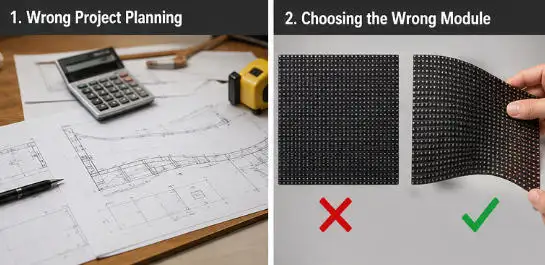
2. Choosing the Wrong Flexible LED Module
Not every flexible LED module is suitable for every project. One screen may need a small bending radius, while another may need higher brightness, finer pixel pitch, or stronger magnetic fixing. Selecting the wrong module can lead to poor curvature, visible seams, or unstable performance.
This is a major source of flexible LED display problems because the wrong product choice often causes multiple issues at once. The screen may look attractive in a catalog but fail in actual installation conditions.
How to avoid it
Choose the module based on the real application, not just appearance. Consider:
- indoor or outdoor use
- viewing distance
- curvature requirements
- frequency of movement or maintenance
- brightness needs
- pixel pitch and image quality
A reliable supplier should help you match the module to the project, not just sell you a product.
3. Poor Structural Design
Flexible LED screens depend heavily on the supporting structure. If the base frame is uneven, unstable, or incorrectly shaped, the display will not sit properly. This can cause visible distortion, gaps between modules, or a curve that looks unnatural.
Many curved LED display troubleshooting cases begin with the structure rather than the screen itself. In other words, the panel may be fine, but the frame is wrong.
How to avoid it
Make sure the structure:
- is strong enough to carry the full screen
- has a precise curve or shape
- keeps all mounting points aligned
- allows for thermal expansion
- leaves room for cable management and service
For complex projects, structural precision is just as important as LED quality.
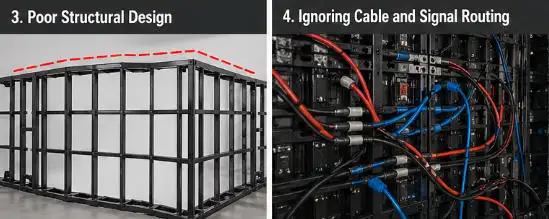
4. Ignoring Cable and Signal Routing
Another frequent problem is messy or poorly planned cable routing. In flexible LED display projects, cables often need to pass through tight spaces or follow curved paths. If the wiring is too long, too loose, or badly positioned, it can create instability, signal loss, or maintenance difficulty.
In some cases, installers bend or press cables too hard, which may damage connectors or create intermittent display failures.
How to avoid it
Keep wiring organized and protected. Use proper cable paths, secure all connectors, and avoid unnecessary strain on signal lines. Label everything clearly so future maintenance is easier.
Good cable management does not just make the project look cleaner. It improves reliability.
5. Uneven Curves and Visible Spacing
When a screen is curved, small alignment errors become very noticeable. Uneven curves can make the image look distorted, while incorrect module spacing can produce visible seams or shadow lines. These are common curved LED display troubleshooting issues, especially in custom installations.
This usually happens when modules are not adjusted carefully or when the cabinet/frame does not hold the intended curve.
How to avoid it
During installation, check:
- whether all modules sit at the same angle
- whether the curve is consistent across the entire screen
- whether the edges are aligned properly
- whether the screen surface is smooth from every viewing angle
Take time during setup. A few extra minutes of adjustment can prevent a very expensive visual problem later.
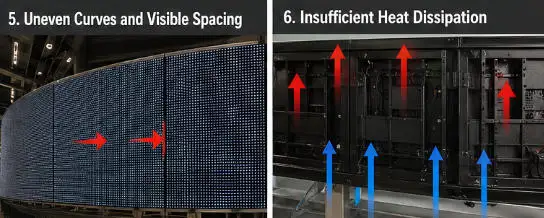
6. Insufficient Heat Dissipation
Heat is one of the biggest long-term risks in LED screen projects. Flexible screens are often installed in compact or decorative spaces where airflow is limited. If heat cannot escape properly, the screen may age faster, lose brightness, or develop performance issues over time.
This is one of the most overlooked LED screen maintenance issues, because the screen may work well at first and only fail after extended use.
How to avoid it
Plan for ventilation from the beginning. Make sure there is enough space for airflow behind and around the screen. If the installation environment is enclosed, use additional cooling or heat-dissipation measures.
A display that runs cool usually lasts longer and performs more consistently.
7. Using the Wrong Power Supply Design
Power problems can cause flickering, uneven brightness, or even complete failure. In flexible LED display projects, the power design must be matched to the screen size, brightness level, and operating hours. A power system that seems “good enough” may still be unstable under real load.
This is one of the LED display project mistakes that is easy to miss during planning but expensive to fix after installation.
How to avoid it
Calculate power requirements carefully. Use quality power supplies, proper load distribution, and stable voltage. Do not overload circuits, and make sure the system is designed for the expected operating time.
Stable power is essential for image stability and product life.
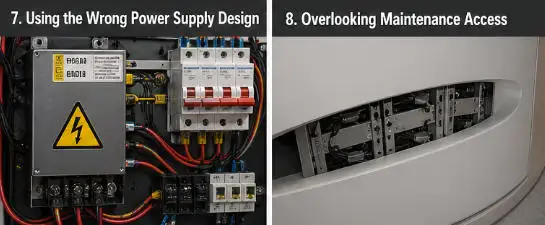
8. Overlooking Maintenance Access
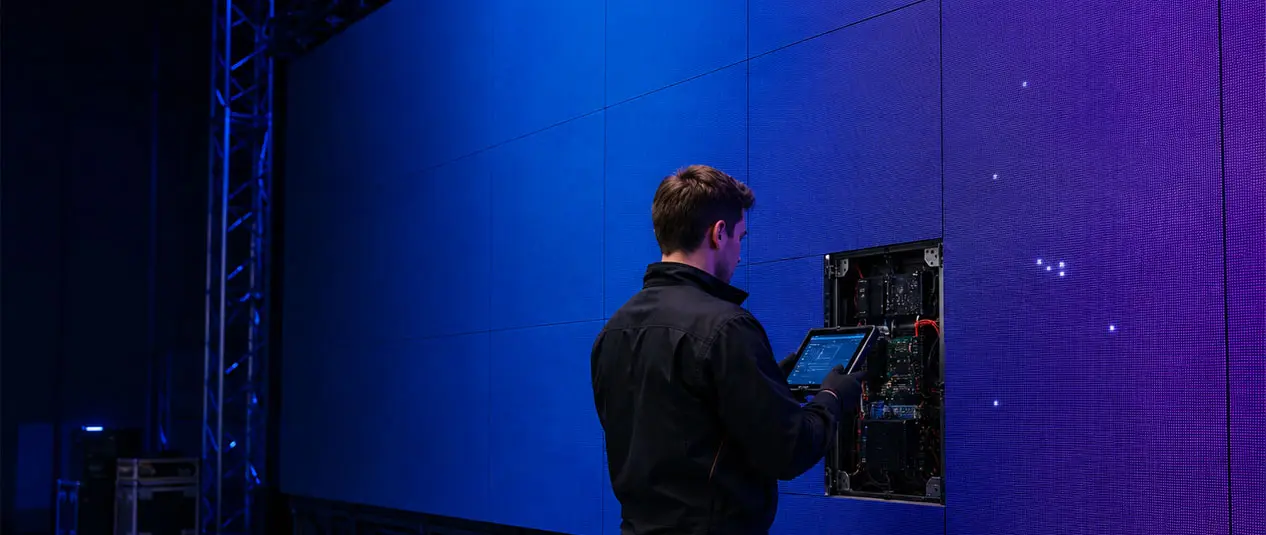
A flexible LED screen should not be designed as if it will never need service. In the real world, modules may need replacement, cables may need inspection, and power components may require checking. If maintenance access was not planned, even a minor issue can become a major repair job.
This is one of the most practical LED screen maintenance issues, yet it is often ignored in the design stage.
How to avoid it
Leave enough space for:
- module replacement
- controller access
- cable inspection
- cleaning
- ventilation checks
A display that is easy to service will cost less to maintain over time.
9. Poor Calibration After Installation
Even when the hardware is installed correctly, the screen may still look wrong if calibration is incomplete. Color mismatch, brightness imbalance, or uneven image alignment can make a flexible display look low quality.
This is especially important in curved installations, where viewing angles may vary across the surface.
How to avoid it
After installation, perform a full calibration test:
- check brightness uniformity
- test color consistency
- verify signal stability
- inspect the screen from multiple viewing positions
Do not treat calibration as a final extra step. It is part of the project’s quality control.
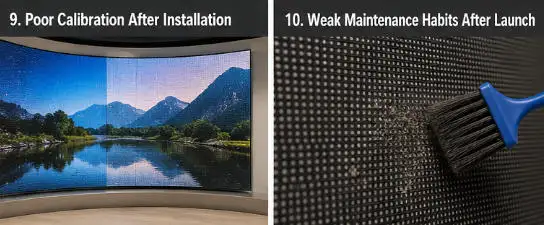
10. Weak Maintenance Habits After Launch
Many LED screen maintenance issues do not come from sudden failure. They come from neglect. Dust buildup, loose connectors, poor cleaning methods, and delayed inspections all reduce screen life.
Flexible LED displays are durable, but they still need proper care. A screen that is checked regularly will perform better than one that is ignored.
How to avoid it
Create a simple maintenance routine:
- clean the screen gently and regularly
- inspect modules and connectors
- monitor temperature and ventilation
- check for image irregularities early
- replace damaged parts quickly
Preventive maintenance is much cheaper than emergency repair.
Practical Checklist for a Successful Flexible LED Display Project
Before you start installation, make sure you have covered the basics:
- the screen shape has been fully confirmed
- the structure matches the design
- the flexible LED module is suitable for the application
- the power plan is stable
- cable routing is organized
- heat dissipation is considered
- maintenance access is available
- calibration will be completed after installation
This checklist may seem simple, but it prevents most flexible LED display problems before they begin.
Conclusion
Flexible LED displays offer outstanding creative freedom, but they also require careful execution. Most failures do not come from the screen concept itself. They come from planning gaps, structural errors, bad wiring, weak cooling, and poor maintenance habits.
By understanding the most common LED screen installation issues and curved LED display troubleshooting challenges, you can avoid costly mistakes and build a project that looks better and lasts longer.
A successful flexible LED display project is not only about making the screen curve. It is about making every part of the system work together smoothly, reliably, and professionally.
If you are planning a custom project, choosing the right product and the right installation approach from the beginning will always give you the best result.
